Saturday, August 25, 2012

Milwaukee Spring + Summer 2012


Bike Project!

For those that do not know I am currently residing in Milwaukee as part of a program that focuses on urban under-served medicine and public health.  Thus, in addition to time in the clinic and hospital, we receive dedicated hours to work on a public health project.  I have been partnered with the Sixteenth Street Community Health Center (a group of clinics in South Milwaukee that primarily work with Latino patients).  My first project revolved around access to healthy and affordable food in the local communities and is detailed in a prior blog entry.  Since that time I have been working on something new...

Biking!

When I first arrived in Milwaukee I was told, hey, there is a pediatrician who is into bikes, you should talk to him.  I did, his name is David Waters (strange coincidence on the name huh?), and we immediately hit it off.  Based off our own experiences with the benefits and joy bicycle use can bring and newer research demonstrating huge gains in health and staggering cost savings if short inner-city trips less than 8km are replaced by bike we set out to see what we could do on the south side of Milwaukee to increase bicycle use. (if you are interested in the article please see: http://www.ncbi.nlm.nih.gov/pubmed/22049372)

After months of connecting with local community members as well as bike shops and organizations involved with bicycle use and advocacy we decided to take a dual-pronged approach of 1) holding an event to create excitement around bicycle use as well as 2) conduct a survey to delineate a more evidence based approach to increasing bicycle use on the south side.  The survey is in it's final revisions but just last Saturday we held the first annual Southside Bicycle Day and it was a huge success!  See pics below:


Our Bike day logo!

 We estimate between 100 and 130 community members showed up!  We had representatives from the Wisconsin Bike Fed teaching about safe city riding, free helmets we fit on kids (ran out and will need more next year), the Urban Ecology Center, The Hank Aaron State Trail (a great riding/walking path along a river close to the community that almost no one at the event had heard of!), Milwaukee Police Bike unit, bike mechanics from two local shops offering free safety checks and minor repairs to all comers, and lastly free t-shirts and food to top it off.


 Officer Lemke from the MPD bike unit and me with a girl who really wanted a pic with us!


Officer Lemke leading a group on one of two groups rides he conducted on the park's trails during the event.  It was awesome to see 30-40 kids and adults stretched out behind the officer in their orange event t-shirts like little ducklings!


Signing kids up for the next ride.


Anton from Ben's Cycle Shop gettin' things done!  Our volunteer mechanics (also Russell from Dream Bikes) were a huge asset to have at the event - thanks guys!


Melissa from the Hank Aaron State Trail about to explain to another participant the wonders of the trail and how to best access it.  Nice!


 Our planning team minus Dr. David Waters who could not attend unfortunately (but has been instrumental in making things happen).  L-R Ed, Tatiana (my "boss" so to speak), and me.  Couldn't have asked for better people to work with!


-------------------------------------------------


Other Awesome stuff I want to share...

Wedding!

No, not mine, my brother Matthew got married!  His wife, and my new sister in law, is Alicia, and we couldn't be more excited to "officially" have her as part of the family!  The big day was July 28th and we held the wedding and reception at my parent's place on Bainbridge Island.  I was worried hosting the wedding would get us all stressed out but in the end we all banded together to get the work done, enjoyed each other's company and that of many family members and friends we had not seen in some time, and had a great day!  The sun even came out right in the middle of the outdoor ceremony - beautiful - we couldn't have asked for more:)  Congrats Matthew and Alicia!

Patrick and me tag-team toasting our brother Matthew and his wife Alicia - great fun!


Couch Surfing!

The title pretty much says it all.  In response to living alone in a two-bedroom apartment and being rather lonely at times I signed up for a website called couchsurfing.  The basic premise is to connect people who are willing to let someone stay with them for a night or two with travelers coming through. I was skeptical at first but the site has each person create a profile you can review and after meeting/hosting the two respective parties provide feedback i.e. "_____ was great to talk with, helped with dishes, and was very neat."  While I am not in a position to travel right now I have hosted some pretty cool people from all over the US as well as India, Germany, China, French and Italy!  And the bonus, the people I have hosted have all invited me to visit them in their countries - essentially I am creating a world-wide network of friends!


Karo from Germany and Spring (adopted name) from China.  We were just sitting down to an amazing chinese feast prepared by Spring!  Spring also helped me clean my kitchen and bathroom without me asking for it (don't worry mom, they weren't too bad to start with:)


Visiting a kite festival on Milwaukee's lakefront with two gals from France who visited me.  They had some huge kites!  The one's in the pic were at least a 100ft long!


Visit from my brother!

The evening after I finished 9 hours of testing for my Step 2 United States Medical Licensing Exam I had the awesome reward of being able to pick up my brother Patrick from the Milwaukee airport.  We had 5 days together and we packed it full of fun and adventure - two 60+ mile bike rides, several smaller rides, time at the lake front, a 10-12 mile trail run, cooking up huge feasts (including making pizza from scratch!), having friends over for dinner, visiting our grandfather and more.  It was a blast to show off my new home to someone who shares so many life passions with me!


The pizza team!  It was my first time making pizza from scratch and it turned out delicious!  L-R my brother Patrick, me, and my former med school roommate Anst who came for a day of adventuring with us.


Using basil from our med student garden we made home-made pesto, then added feta, brocolli, and mushrooms to top it off - yum!


Surgery Sub-Internship

From the above stories/pics you might think I am no longer in med school but this is not at all the case!  The fact that I only have time to write every few months is testament to my normal state of affairs:)

Third year ended well, I took my step 2 exam and I am now nearing the end of my first clinical 4th year rotation.  In the 4th year we are able to set our own schedule as long as we meet certain requirements.  I have started out with a month of general surgery and had the good fortune of being with a surgeon who is amazing and breaks all the stereotypes.  Dr. A loves to teach, is an incredible communicator and beloved by his patients, and has provided me with a great deal of responsibility and learning opportunities.

For example, one of the days we were on call Dr. A was in the operating room (OR) when he was paged by the emergency room (ER) that they had a patient with CT evidence of a perforated appendix and free air in the abdomen.  In medicine, free air is almost synonymous with a speedy trip to the OR for emergency surgery.  It usually indicates there is a hole somewhere along the person's intestinal tract and the patient is in acute danger.  Being scrubbed-in on a case Dr. A asked me to go to the ER in his stead, evaluate the patient, and report back to him with what I thought we should do.  Yikes!  This was the real deal!

Trying to remember the key history and physical elements of appendicitis and the criteria for sepsis I hurried down to the ER.  The patient I encountered was a 69-year-old man from a nursing home, wheel-chair bound after two strokes, with bad COPD (a bad lung disorder) and numerous other medical conditions.  While he was uncomfortable and had a distended abdomen he was not in acute pain and I could find no signs of peritoneal inflammation (certain signs that tell us extreme badness is happening inside the abdomen).  From what I could gather his intestinal perforation likely took place a week or so ago and what had brought him in acutely was nausea/vomiting and food intolerance secondary to his intestines becoming blocked or ceasing to function due to the inflammation/irritation within.

With his many co-morbidities and stable clinical picture I did not think taking him to the OR emergently was a good plan and might in fact do more harm than good.  However, I did not know if this was correct and bounded upstairs to share my assessment and plan with Dr. A.  After hearing my presentation he agreed with me (!) and upon seeing the patient himself he reaffirmed the plan.  Our patient is still in the hospital but has made moderate improvements and so far it has not been necessary to take him to the OR.

Needless to say, experiences such as this have provided me with a great deal of learning.  As I continue to gain more knowledge and confidence it has been most exciting!

Well that's all for now - please write back if you can!


Sunday, April 29, 2012

Milwaukee

Starting in January I moved from Madison to Milwaukee to begin my 1.5 year long participation in the TRIUMPH program (TRaining In Urban Medicine and Public Health).  TRIUMPH focuses our learning on the needs of urban underserved populations and integrates public health into our clinical training.

There are 8 of us total, each person working with a local community partner on a variety of projects. I have been partnered with the Sixteenth Street Community Health Center (SSCHC) located on the near south side of Milwaukee.  They are a federally qualified health center with family docs, pediatricians, mental health specialists and more and they specialize in working with the Latino community.  In many ways it reminds me of SeaMar where I worked during Americorps.

(The TRIUMPH team!  A wonderful group of people.)


My role at SSCHC has evolved into two separate projects united by a common goal.  The goal is wellness promotion in the Latino community and specifically reducing obesity.  My first project assists a educational program run through the clinic called Healthy Choices.  It consists of 3 months of once per week 2 hour classes that each incorporate a main lesson ranging from why water is better than soda to the benefits of whole grains as well as introducing new types of exercise each session (yoga, zumba and more) and finishing with a healthy snack.  The program is targeted at the entire family and indeed there are 4 different curriculums for different age ranges (4-6 year olds, 7-11, teens, and adults) who all focus on the same message of the day but with age appropriate material.  The participants come to support each other and many a parent has said it is their child who begs to go and continues the family's participation!  

Graduates of the program feel they know how to eat healthier but do not know where to get healthy food at the best price.  My task was to visit 10 local supermarkets and find out which one's had healthy options and at what price.  After doing this I created a comparative shopping guide we now provide to the families and also gave several presentations on the results of the study.  The main findings were:
1) there is a great deal of variety in the availability and price of healthy food items in the neighborhood between different stores.
2) The supermarkets marketed to and most frequented by Latinos had the fewest healthy options and those they did have often had the highest price tag.
3) It is possible (theoretically) to buy healthier food and save money in the neighborhood (buying less meat is a key part).


(At one of the presentations.  I had to learn a few new words such as ajonjoli (flax seed) which was a tough one for me to pronounce!)


My second project is only just beginning and the goal is to increase bicycle use and appreciation in the near south side of Milwaukee, especially within the Latino community.  A dream of our team is to one day hold a Ciclovia.  For those who do not know what this is check out an example at the following link: http://www.ciclavia.org/about/
More on this project in the future.


Recent Life Highlights/News

OB/GYN:
Crazy rotation but I really enjoyed it.  Working in one of Milwaukee's large public urban underserved hospitals we encountered all kinds of extreme cases and I think I saw almost every major obstetrical (having babies) complication there is!  See my previous post from February for a story about one of them.

Am I in Alaska?:
First, let me set the stage with a little background info. Milwaukee sits on the western edge of lake Michigan and right through the middle of it runs the Menominee river valley. This symbolic rift divides one of America's most segregated cities, with the North being mostly African American and the south largely Hispanic. In bygone days the valley was the engine for Milwaukee's industrial powerhouse and as a result the river became incredibly polluted over time. Several decades ago the city decided to clean up the area and from past photographs you almost wouldn't recognize it now. The river meanders along forested banks and on land there are a plethora of new, greener, businesses and an awesome bike/walking path that goes from the lake many miles inland called the Hank Aaron State Trail (HAST).
(The HAST!) 

My first day biking on the HAST I noticed two people walking around in the shallows of the Menominee river. I had learned some of the info I shared above but still thought it not the brightest idea as I figured the river was probably none to clean after so many years of abuse. As I grew nearer I could see they were fly fishing and stopped to watch. This seemed rather futile as there couldn't possibly be any fish in the river. As that thought passed through my head I saw one of the men's poles give a heave and proceeded to watch them reel in some huge trout/salmon looking fish which I later came to learn was almost assuredly a cut-throat. I couldn't believe my eyes! It felt like I was in the middle of the wilds of Alaska!  Yet, a glance behind me revealed several sky-scrapers.  Definitely in the city.  Crazy.  So, if you want to come visit, don't forget your fly rod:)

Third Birkebeiner ski race: Due to a profound lack of snow this winter I skied exactly 3 times before the race this year. However, the cross training I got from biking the snow-free streets must have been enough as I did the hilly 50k course in my second best time (3:45 vs 3:30 last year and 4:05 my first year) which I was more than happy with.  XC skiing rocks!


Hanging out with my Grandfather: One of my original hopes when coming to Wisconsin was to reconnect with the substantial number of relatives on my mom's side of the family who call WI home. I have been able to spend time with many of them (all wonderful experiences - thank you!) but was really hoping to see my grandfather more. My new location in Milwaukee is just 5 miles from where he lives which as allowed us to get together on three occassions so far for such adventures as:  baking bread, watching Wisconsin in the March Madness tourny,  practicing knot tying, and the telling of many awesome stories (i.e. my Gpa recanting such incredible tales as how he was shot down in WWII, survived, was held prisoner, and eventually escaped).  I have an awesome grandfather.

(Preparing to chow down on one of the meals we created)


Bikes: Maybe it's because I'm working on a project to get more people biking that I've had bikes on the mind but for whatever reason I've been exceptionally excited about them and riding them all over. I've discovered an incredible network of paved and off-road paths/trails around the city and each weekend go out exploring more of them. On my last rotation (primary care) I had two clinics set at opposite sides of the city but I still wanted to bike. The round trip ended up being just over 30 miles but as my afternoon preceptor didn't start until 2pm I had enough time to bike the hour plus down to her clinic after my morning clinic. I think I might be in the best biking shape of my life from commuting so much! The downside of such high mileage with a pack on was lots of pressure on my wrists and "areas that don't like lots of pressure" so I recently got a rack and some panniers.  Best decision ever; I can't believe I didn't make the switch earlier!

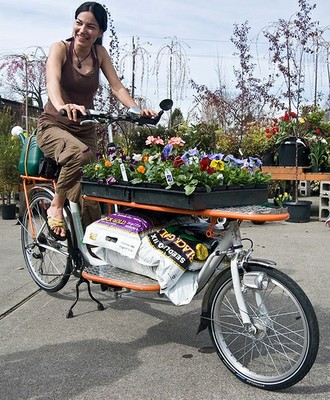
I've also become enamored of cargo bikes recently.  They can carry so much stuff you don't hardly need a car anymore!

(A smiling lady I do not know on a sweet cargo bike)

If you want to see more check out this awesome video of cargo bikes: 


Plans: In early January 2013, bar any unforeseen roadblocks, I will be heading to East Timor for 6 months to work in clinic and small hospital.  East Timor is roughly 400 miles NW of Darwin, Australia in SE Asia.  At that time I will also be assisting a Maternal Child Health Project that trains skilled birth attendants to help reduce the staggeringly high maternal and neonatal mortality in the country.  In preparation I am learning as much Tetum as possible (the most commonly used local dialect) and luckily have been put in touch with two fluent speakers who have graciously been my informal instructors for help with pronunciation and tricky grammar.

Ita diak ka lae?

To learn more about the clinic see:
http://bairopiteclinic.org/welcome/


Finale:
This video blew my mind.  Earth is an amazing, and fragile, place.  This video made that message hit home in a powerful way.
http://www.youtube.com/embed/nGeXdv-uPaw

Thanks for reading!


Sunday, February 5, 2012

Crash

Note: The names have been changed to protect identity.

Maria came up to the floor in the middle of the night already at 5cm and pushing. Her and her husband spoke only Spanish and yet there was no available Spanish translator. I volunteered that I could communicate with them as I speak Spanish and introduced myself to Maria and her husband Juan. Between contractions and with Juan’s help we were able to get a brief history. Maria was a 34-year-old G4P3-0-0-3, all uncomplicated vaginal deliveries. We tried to calm her and get her to stop pushing until she was fully dilated but it was to no avail. Eventually she reached 10cm but by this point, hours later, she was thoroughly exhausted. With her permission we elected to pursue an epidural to see if getting her pain relief and rest would allow her to recover and push again. Just after the test dose of the epidural went in the fetal heart tones dropped into severe bradycardia and did not rebound.

A tense minute passed and then there was organized chaos. Nurses grabbed Maria’s bed and hauled it out of the room, someone was on the phone yelling for the operating room to prepare for a crash c-section. I tried to explain to Juan why all of sudden his wife was being rushed out of the room for emergency surgery. After showing him where he could wait outside the OR I headed in just in time to see the fastest “birth” I have ever witnessed. From initial incision to removal of the baby was under a minute. Examining the uterus the cause of the bradycardia was found. On the posterior aspect of the uterus was a gaping hole – spontaneous uterine rupture. The odds of this happening to a woman with no history of uterine surgery are infinitesimally small but there was no arguing with what had happened. The team worked valiantly to repair the uterus but could not control the blood loss. The massive transfusion protocol was activated and after 4 units of packed red cells the team elected to remove the uterus to save Maria’s life. By this point a Spanish translator had arrived but as they had to stay with Maria I was the one who would exit periodically to update Juan. His baby had been taken to the NICU and was doing well. We went to visit the baby but Juan’s attention was focused on his partner. He kept repeating that all he wanted was for her to come out of those double doors alive.

Two days later I was finishing up a last errand when I heard someone call my name from down the hall. I turned to see Juan and his three children. A big grin was on his face. He thanked me for being with them two nights prior and introduced me to his kids. They were on their way to post-partum to meet up with Maria who was being transferred there after recovering well and being discharged from the ICU. After helping them figure out how to get into post-partum I left, my face splitting into a smile. As a medical student there are many days where I wonder what if any contribution I am making. On that night though, I knew my contribution had meant a great deal to Juan and Maria. This experience reinforced for me the importance of communication with not just the patient but those that care about them as well. It also reminded me that as medical students, while we may not have much clinical experience yet, we can still be an important part of the healthcare team.

Sunday, October 9, 2011

A bike ride and a story

I am at a new site for my clinical pediatrics rotation, La Crosse Wisconsin, and we have been having uncharacteristically warm and amazing weather for October. Not that I am complaining by any means!


(Looking over La Crosse from the bluffs above the city. Far off you can see a shimmer of the Mississippi River)


My former roommate Anst (yes, sadly I no longer live with Anst but we obviously still keep in touch) and I decided to celebrate the day with a long bike ride through the countryside. We had heard stories of huge hills and beautiful scenery and so we went searching.


(Anst on the road!)


(It wouldn't be Wisconsin without some corn!)


(Anst leading the way into another round of hills. There were three main climbs each one a good 10-15 minutes of solid uphill)


(There were lots of neat old barns and farmhouses along the way.)


(Me riding along. Anst and I began experimenting with taking pics with both of still riding. The sun was nearing the horizon as we drew close to home - what an incredible ride!)


-------------------------------------------


And now, switching topics, I have an experience I want to share. This happened last Friday and I've been thinking about it a lot so I decided to try and put some of it in a more concrete form.

The Message:

How do you tell two parents that their darling 4-year-old son, who they brought in for mild shortness of breath, in fact has a tumor occupying his entire pelvis, much of his abdomen and extending into his chest?

This is not a question I usually ponder, but last Friday I was doing exactly that.

I followed our pediatric oncologist Dr. Ettinger, or Dr. Bob as he is known by his patients, into the conference room with Charles' parents and one other medical student. We all sat around a small circular table. It was late in the day and the sun's last rays streamed into the corner room and lit up Dr. Ettinger's dark brown eyes and wisps of his beard as he gazed across the table at Charles' parents. Charles' mother's sweater bulged noticeably, denoting where the couples' next child had been growing for the past 35 weeks.

"Why don't you tell me when you first noticed something out of the ordinary," Dr. Ettinger began softly.

Their son, we will call him Charles, had been feeling well until the Monday before his admission. Maybe a little more tired than usual but nothing too out of the ordinary. Then he started to complain that it was a little harder to breath. But still nothing too bad, nothing to really worry his parents. A visit to their pediatrician had concluded with no remarkable findings. However, the shortness of breath persisted and they took him back to the doctor on Friday. On physical exam he had a clinical picture of pneumonia: shortness of breath, crackles upon auscultation of the lungs, fever and on chest x-ray some fluid building around his lungs. His abdomen also seemed a bit full. On the hunch that something didn't seem quite right his physician ordered an abdominal ultrasound. The technicians running the scan immediately called the ordering provider. As a doctor you never want the scanning technicians to call you immediately. It is never good.

The CT scan that was done immediately after gave a sharper image of what was going on. Tumor everywhere. But even with the tumor compressing Charles' bladder to the point where we could barely identify it on the CT scan, encasing much of his liver and bowels, and wrapping up into the anterior portion of his chest his body had compensated well. As they have been teaching us since day one, kids will compensate until they crash. And now Charles had massive amounts of fluid in both lung cavities and arguably more tumor than internal organs.

Dr. Ettinger took notes quickly in a typical unintelligible doctor scrawl. After relating the story Charles' mother spoke again, "we should have noticed something sooner, now that I think about it he had seemed a little off the week prior to all this. But you know, kids are always getting sick this time of year and..."

Dr Ettinger broke into her spiraling thoughts, "I am going to tell you something and you have to believe me. You got him here as quick as you could.” His deep voice was firm. “There was no way you could have noticed this earlier. Charles' first sign that something was not right was his shortness of breath, and you got him in just when it happened. You did a good job and you must not go down that road of what ifs. We need to look forward now."

Charles's mother choked back tears but seemed to steel herself.

"Is there any information you can give us about his chances?" Charles' father asked.

Dr. Ettinger cleared his throat, "right now we do not know what kind of tumor this is and that makes all the difference for what treatment we use and what the statistics are. But I want you to know this. If the tumor Charles has, has for example a predicted survival of 60% it really doesn't matter to Charles. For him, he will either get better or he will not. And I am going to do everything in my power to make sure he does get better; until he tells us he cannot. So for all of us, what we need to do is focus on helping Charles."

"There is something else you should know," Continued Dr. Ettinger, "I will never lie to you. The truth will at times be very painful but if we do not trust each other there is no way we can work together for Charles' best interest."

"And what should we tell Charles about all this?" his mother inquired.

"Right now we tell him nothing.” I was shocked to hear Dr. Ettinger say this but then he continued, “We tell him we are doing tests to try and find out why he is not feeling well. However, once we find out what we are dealing with, probably midweek of next week, we tell him everything but in terms he can understand. Trying to hide the truth from a child never works. I have been through this scenario many times before and you must know this is not like the movies. Not everyone gets better even when we do our best and the hard times to come more often divide families than bring them closer. You will both need to support each other like never before and be able to rely on those that care about you.”

Dr Ettinger continued, "We have a team of doctors, nurses, social workers, child therapists and more here who will all be working on Charles' behalf. I have one partner, Dr. Peters, who I co-manage patients with but I want you to know you have 24/7 access to me. And above all, I want you to know that I am your child's advocate. If you want to seek a second opinion I will help you to do so. Myself, and everyone you will meet here, will do whatever we can to help Charles.”

As we left the conference room I watched Charles' parents walk down the empty hospital corridor. They each placed an arm around the others back for the final stretch before turning into their son's room.

I knew I had just witnessed something very sad and very powerful. There are many ways in which one can witness an inspirational masterpiece. Some individuals can play a piece of music so beautifully as to bring people to tears, others can use simple paints and a canvas to take a person's breath away, while some gifted humans can make a one-handed diving grab into the end-zone. What I had just experienced felt like a masterpiece of a different sort. Dr. Ettinger's kindness, honesty, experience, and compassion had been woven together to provide perhaps not what Charles’ parents wanted to hear, but what they needed to hear, and formed a foundation for what would arguably be the most intense experience of all their lives.

During the entire conversation I had remained silent but my body felt like it was humming, vibrating at an imperceptible speed. I felt hyper-focused and infinitely present. That moment, being there to work with a family like Charles’, this is why I am becoming a doctor. Having the knowledge to counsel a family is one thing. Having the experience, humility, honesty, and empathy to deliver that knowledge to a grieving family is quite another hurdle. But one I look forward to building towards in the years to come.

Sunday, March 20, 2011

Haiti

Haiti. The poorest country in the western hemisphere. Ravaged by an enormous earthquake in 2010 and struggling with cholera outbreaks more recently. I had read a fair amount about Haiti over the past several years and when the opportunity to go there with my roommate Anst (who is from Haiti) arose I jumped at the chance. The purpose of our trip was not medical in nature but rather an opportunity for me to see where my roommate had come from, meet his family, and explore the mountains where he was born. To see if the Haiti I had read about would match my reality of it. I expected to see a great many people scrapping out a living amidst refuse and dust, and this I did encounter, but what I did not necessarily think to expect was the beauty of the mountains or the incredibly kind welcome I was given by Anst's family.

Below I have shared a number of select stories and photos from my week in Haiti during March 2011.

stories:

1. Border Crossing

2. Running From?

3. Family

4. The Citadel and…

5. The Mountains of Anst’s Birth

6. Community Mental Health in Haiti
-------------------------------


(A coastal view on the way to visit a clinic Anst has worked at in Borge.)


1. Border Crossing

Anst's family lives in a town close to Haiti's border with the Dominican Republic (DR). Thus, to expedite our arrival we decided to fly into a city in the DR and cross over from there. We planned our flights to make sure we would be in plenty of time to get to the border before it closed at 6pm. At least, we had enough time until our flights got horribly delayed, we slept the night in the JFK airport on the floor, and arrived quite a bit later than planned. The race was on and we caught a taxi to the bus station and then got the first bus available to the border crossing. In the DR I actually got to feel useful as my Spanish was understood and I could make out the fast/slurred DR Spanish well enough.

Exiting our bus in the small border town I could see the sun setting in the west where we needed to head. We didn't have much time. Anst signaled a man on a motorcycle over and after we failed to get both of us on the back with all our bags he called over a second man and we took off through the streets, the rays from the lowered sun blinding me as we headed out. I was doing a fair amount of praying at this point that (A) I wouldn't fall off, (B) we wouldn't get blind-sided by a truck as we blazed through intersections and (C) this man actually knew where we needed to go and had understood our request for said destination. Fortunately, A,B, and C came to pass and we jumped off and paid the men at the start of a large bridge which I reckoned would take us into Haiti. We started running toward the gate and hit a crowd as we neared it. All of a sudden a man in camo was jabbing a large gun in our faces and demanding our papers. I showed him my passport but Anst didn't understand the man who was speaking in Spanish and it took him a second longer. The man shouted louder and I told Anst what he wanted which got the gun lowered (it seems to be a universal communication strategy that when someone doesn't speak your language if you just say it louder then they will get it). After perusing our passports for 30 seconds he deemed us "worthy" and let us cross even though I was now pretty sure the border was closed. Anst would later tell me they do this for white people which is why they can be useful traveling companions for border crossings.

As soon as we made it onto the Haitian side of the bridge we were enveloped by an even larger crowd, now all black, with people cleaning up from market, motorcycles revving and people shouting at us. I was a bit taken aback and tried to focus on making sure I had my bags tight on me. Anst looked upset and as I couldn't understand a word of Haitian Creole this made me pretty worried. Eventually we both got onto a motorcycle with a man named Judah who took us to get our passports stamped. Unfortunately the office was closed as we had crossed too late. We would return a few days later to straighten things out but I can now say I have illegally crossed a border.


(A typical view of road traffic. In two words (at least to me) absolute mayhem.)


(Kids coming back from school. In Haiti uniforms are the rule.)


(UN tank. The closer we got to Port au Prince the more we saw. Anst was not happy about the UN's presence.)


2. Running From?

On our second day in Haiti Anst took me the country’s second largest city, Cap Haitian, or just "Cap" to the locals, to meet his mom and cousins. Once in the the city we headed out from one cousins apartment to go visit another cousin that Anst wanted to check in on (Anst has an insane number of cousins!). It was market day and the already narrow streets had become walking room only with various stalls made of old sun-baked wood or even simpler setups comprising black plastic laid out with wares upon it. Shoes and various pieces of unidentifiable metal are two vendors I recall.

All of a sudden there were people running toward us and screaming. Anst turned and told me to run and keep my head low. We surged along in the mob, my heart racing, finally taking a side street and escaping the stampede. "what was that?" Anst said he didnt know and that he thought he heard rocks were being thrown. My mind turned to the UN force here and I wondered if people had been attacking them in anger. It had recently been discovered that the strain of cholera infecting Haiti came from Nepal and there were several units of Nepalese in the UN force. Some Haitians had accused the UN of infecting Haitians on purpose and Anst had told me before arriving that things were tense in some areas.

We decided to head a different direction. Within 2 minutes, wham, another screaming crowd surged towards us and this time Anst grabbed my wrist pulling me along at a crouched sprint, stepping through people's wares, half jumping as they scrambled to get out of the way, once again my eyes wide and breath racing. As before, we didn't see what had caused the mob and Anst decided he would see that particular cousin another day.

I had never been in a mass mob running from some unknown fear and it was an experience unlike any other I have had to date. Suffice to say I don't feel the need to do it again. I can only imagine what it might be like to live in a place where of the sort of fear I experienced in those brief moments is a daily occurrence.


(A stream close to where Anst mom lives. I don't think I saw a single garbage can the entire trip. Everything got thrown wherever. One memory that sticks with me in this regard is the ground around the "bus station" (gas station designated as a ride transfer point). There were so many squashed plastic bottles on the ground it felt like I was walking through fallen leaves in the fall time.)

One of the things I kept thinking about after returning to the states was how much space we live in! It's insane! By Haiti standards I should be housing at least 15 ppl in my apartment. Gosh...


3. Family


My previous two stories might give the impression that my time in Haiti had me constantly fearing for my life but this was not the case. Being with Anst, in areas he knew, made me feel quite comfortable and everyone I interacted with on a more involved level was kind to me. Anst’s family in particular was most welcoming and I tried my best to learn a few phrases such as "manje bon apil! - very good food!" and "bonswa, komon ou ye? - good afternoon, how are you?") to express my gratitude for their housing me and treating me well. I got to the point where I could fire off a few introductory phrases and people thought I spoke some creole but then when the follow-up questions came it was immediately obvious that I had reached my limit:) Anst's family seemed huge to me and every other second there was a new cousin or uncle to meet. Anst's cousins who we spent the most time with seemed to take the view that because Anst had deemed me worthy of bringing to Haiti I must be ok and thus they accepted me. This was much different from my time in Ecuador where it took much longer for me to come to know the people around me (as I was an outsider). I did my best to fit in, eating whatever was presented (which was really quite easy as the food was all delicious), sleeping wherever I was told to, pulling water up from the well and taking bucket showers like everyone else, using pit toilets, etc. To be honest it felt somewhat like I was doing urban camping at times! After the trip I received feedback from Anst that his family had liked having me around quite a bit but that I wasn't quite what they expected from an American as I had for example, climbed trees with Anst and gone on mountain trail runs... and I really seemed to enjoy it!


(This small entryway into the two room bottom floor "apartment" owned by Anst's family in Cap has to be the most versatile space I have ever seen. Besides being an entryway, it also served as a spot to bathe (bucket showers baby!), to urinate, and to wash and hang clothes.)


Being immersed in a language I did not know was an experience I had not had in some time as my more recent travels prior to Haiti had been to Spanish speaking countries where I was just fine language wise. It re-invigorated my desire to learn an additional language and at this point I'm debating between French (useful in France and many African Nations) or Portuguese (quickly becoming the family second language as mom grew up with it and my other two brother are learning it/traveling to brazil). Regarding language utility my English was for the most part useless but as Haiti shares a border with the DR there were a fair number of people who spoke at least some Spanish and this proved a lifeline for initiating conversation of more than two exchanges. Some of my favorite memories are from sitting outside the family apartment in Cap Haitian in the evening with a few of Anst's cousins and friends, watching the light fade and talking about whatever, in a mix of haitian, english, and spanish often with random people from the street who would come over at the sight an unknown pale stranger. Until reaching Port au Prince (the capital) at the end of our trip I saw perhaps 5 other non-very dark skinned people in all our travels. The feeling of being different from everyone else with eyes constantly on me was stronger in Haiti than in any other country I have been to.

The strangest encounter I had due to my whiteness came during a late night visit to a sandwich shop. A quick preface to this that you must know is that during my trip to Haiti my facial hair was the longest it has ever been. While waiting around for our food a party of three came in to order. One of them glanced at me, did a double take and excitedly started whispering to her friend. The group of them all started laughing (always great to make fun of the person who can’t understand right) before Anst asked them something in creole and then he and our group started laughing as well. Now I really wanted to know what was up and finally got Anst to tell me. He said the girl thought I looked like Jesus. It was true I was white and had a beard but that was about it. I tried to imagine how this could be and reckoned that if the only black person I had ever seen was pictures of Michael Jordan and then one day I saw a tall black man with a shaved head, well, I would probably think he looked like MJ!

Since returning to the states Anst has informed that his family often inquires how I am doing and to say hi. I hope to visit them again at some point in the future.


4. The Citadel and…

Ever since Anst and I started planning our trip he had been telling me about an epic super steep/long hike up to an old fortress that we had to do. We completed the hike with a cousin and friend of Anst (both of whom had to get a truck ride part way up as they could not keep up with Asnt and me☺) but it was someone I met along the way that makes the day stick in my mind. First though a few pics:


(the fort)


(A view from the Citadel)


(Anst and me on top of the Citadel)

The hike up was indeed very steep and took us over an hour to reach the top. As the pics show it was an impressive structure and provided a panoramic view of the surrounding area. About ¾ of the way up a young man came out to try and sell us (me) something touristy. I wasn’t interested and tried to politely decline but he was rather persistent. We hadn’t really stopped to talk and he had followed a half-mile or so when I finally tried a new tactic and invited him along to come to the top with us. He was game and we upped our pace. In talking with the young man, Jimmy was his name, I came to find out he was 18 years old and already spoke 5 languages to a relatively high level (Creole, French, English, Spanish and one more I cannot recall). He had completed all the schooling available to him and despite his clear intelligence and love of learning the only employment available to him was selling trinkets on the roadside. His sense of entrapment and frustration was palpable. Jimmy put a face to the hoards of young men I had seen every day just standing around the streets of Haiti with nothing to do. Being a trash worker? The service doesn’t exist. Join the army? There is none (the UN patrols Haiti currently). Become a nurse or doctor? Requires advanced school not available to most (and many institutions were crushed in the quake). In medical school I am certainly busy and stressed at times but talking with Jimmy reminded me of the great privilege it is to be able to continue one’s studies, especially in an area I am passionate about. I’ve talked briefly with Jimmy since returning to the states but at this point don’t really know what I can do to help him with his predicament. I’ve tried to find if there are any scholarships he might be able to receive but so far no luck. I plan to stay in touch and hope I can help him reach his goals in the future. Let me know if you have an idea or know someone who might.


5. The Mountains of Anst’s Birth


Another venture I had discussed with Anst before traveling to Haiti was taking a trip by motorcycle to visit the site where he was born in the mountains and to check in on relatives along the way. From previous readings about the mountains of Haiti I expected most of the trees to be cut down and the rivers to be polluted. This may be the state of things in certain parts of the country but it was most certainly not the case in the areas we visited. Beautiful clear rivers that we swam in, massive wooded valleys, peaks with panoramic vistas and a patchwork of trails and communities connecting it all with some communities accessible only by foot! I was not expecting the beauty we encountered and now understand much better what Anst had meant when he would tell me back in Wisconsin that this was his place to come rest and feel at peace.

Beyond the natural beauty I encountered was the kindness and hospitality of his extended family. Anst has relatives all over the mountains and each one we visited prepared us incredible food and spent time with us joking and catching up. One family’s baby crawled over to me and wanted me to pick him up which after receiving the OK I did. This was a bit shocking to me as I was a complete stranger to them but once again it seemed that if Anst trusted me enough to bring me here I was good enough to hold the baby!


(On the road!)


(A brief rest stop on the motorcycle journey)


(A fairly representative section of the road we traveled on. Let’s just say being on the back of a motorcycle that is too small traveling over extremely rough roads equals very sore legs + butt.)


(Anst standing on the land where he was born. The small house no longer stands but he knows exactly where it was. It was a powerful experience to watch him point and say, “I was born here.” He feels a connection to his birthplace and the lands around it in a way I will never feel about the large urban hospital where I was born.)


(There is nothing like coconut milk/water when you are thirsty. So good!)


(Anst getting said coconuts. The man can climb! In one of the communities we visited in the mountains there is a young man who is mute but known by all because he is the best climber and will scale 50 ft trees with no problem!)


(A view overlooking the land where Anst was born and where his family still owns land. In fact, the day we headed out Anst's uncle was overseeing the construction of a new small home made from branches and adobe they could use in the future.)


(Anst and two of his cousins, Romy and Woodsy, who remind me more of brothers to Anst than cousins. I saw much in their relationship that I see in the connection I have with my brothers.)


6. Community Mental Health in Haiti


This last section stems mainly from our time in one of the remote communities in the mountains.

Pulling up in the late afternoon on our motorcycle an immediate crowd started to gather. Most kept their distance but one lady came right up to me and said hello. I knew that much and answered back, “I am well, how are you?” From there she started talking fast and getting excited. I also thought she seemed to be getting a bit frustrated with me. I asked Romy (who speaks some English) what she was saying and he told me to ignore her, that she was just a crazy lady. She kept talking to me and I finally got Romy to translate a bit of what she was saying and it indeed was more or less nonsensical. I saw the same woman several times over the next few days and she was often talking out loud with no one around. After my second year of medical school I would guess she had a condition such as schizophrenia but at the time I only knew she was not at all like the other people around her. The really interesting part for me however, was to see how the rest of the community treated her. She was clothed appropriately and seemed well nourished. Someone had to be caring for her. The other people in the village didn’t ignore nor did they overly engage her. She would wander around town and people wouldn’t stare or shy away. Everyone just seemed to accept her as she was. She may have been “crazy” but she was a member of this village and everyone was fine with it; they didn’t lock her away or make fun of her… they just let her be… It was a far different model than the one I have grown up with here in the states to say the least where having a mental health disorder is hugely stigmatizing and many of those with more severe illness end up on the street scraping out an existence from handouts and living under bridges. I think we could learn an important lesson from the Haitian community I visited about how to care for and interact with people who have a mental illness.

Well, that is all. If you read to the end, wow, thank you for taking the time to connect with me in this way. Warm regards, Michael.

Tuesday, August 17, 2010

California

The final leg of my journey this past summer (I know, these posts are a bit late) was 4 days spent with my family in a cabin in the mountains near Lake Tahoe. I got a bit of a shock upon arriving at the airport where a friend of my dad's was there to pick me up.

"When was the last time you talked with your family?"

His comment made me feel a bit uneasy, "Uhhh, 2 months or so, but we've been emailing... why?"

"Well, your mom broke her leg."

"What!?!"

"But she's ok."

"phew... OK... what happened?"


And she is OK. But it was a good shock to me at 12am after a day of traveling. It turns out my parents and brothers had decided to do a hike down to a river and camp the night a few days before I was to arrive. That was the plan at least.

The hike ended up being longer and more arduous than they had planned and in one slippery spot my mom went down and instantly felt a shooting pain in her leg. She tried to walk and was unable to. By this point my brothers had forged ahead to set up camp early and thus my dad had to tear off after them to get them to return and help. They got my mom to a comfortable spot by a creek close by and decided to spend the night and see how the leg was in the morning.

No better it turned out. They had a good 7 miles to get back to the cabin, up out of a valley, over rocky terrain. Using Patrick's hiking pack and a flat piece of wood they forged a carrier and proceeded to take 10-15 minute turns carrying my mom up out of the valley. It was slow going and they had only gone a few miles after most of the day. Just at this time though they happened to meet some rangers out doing wild life tallies who just happened to have their truck nearby on a fire road my dad wasn't aware of. Saved!

The story has gone down in family lore and the piece of wood my mom sat on for 7 hours as they hauled her out now sits on my parents mantel.


(At the cabin with my mom recovering and my brothers making faces)


When I arrived my brothers had gone back down to the river and My dad and I hiked down to join them the next day. It is one of the most beautiful spots I can think of that isn't a national park type area and I wanted to share a few photos. Note, for those of you familiar with it the countryside shown in these photos is a part of where the Western States 100 miler is run each year.


(Devil's Peak)


(Long lake - so blue!


(A big tree with my dad)


(At camp. this camp was pretty decadent for camping with a great fire pit, nice sitting stones, flat tent spots, hanging trees - the works! five stars.)


(A waterfall we descended by climbing down the first part on the side and then jumping off the second fall.)


(Matthew taking the leap! We three bros adventured down-river, jumping from rock to rock, swimming when needed, and jumping down waterfalls as often as possible. We would toss our dry sack of supplies over the edge and then head after it! Sometimes with falls of over 50ft!)


(Click on this one to get a bigger version. See if you can find Matthew in the upper right corner:) this was about the biggest one we went off.)

The trip was a capstone to a great "last summer of freedom" before coming back to start second year. which, as it is now more than half over with has for the most part been an enjoyable experience!