Sunday, March 10, 2013

Over the hill and across the river.

In order to better reform the Bairo Pite mobile clinic program we were recommended to accompany Dr. Aida Goncalves (a Timorese doctor trained in the US who runs her own community health program with funding and support from a Japanese NGO called Frontline) on several of her community visits.

Our four wheel drive vehicle before we got a
flat tire.
Dr. Aida (left) and nurse Pinky (a volunteer from the
Philippines); Aida may be petite but she is a firecraker!

And what great experiences they were!

We have now accompanied Aida to two communities and learned a great deal on what it takes to make community based health promotion successful as well as learning about the challenges inherent to such work in Timor.  What follows is a description of a trip with Aida and team from February 15th 2013 with several clinic pictures spliced in from our first trip.

The ride out to the rural community of Sare (pop. Approx 3000) started along the main road heading west out of Dili.  You might think this would be a decent size highway but the truth is there are no highways in Timor.  Nope, none.  Barely wide enough for two cars to fit past each other, pot holes a welcome site compared to the many rough unpaved sections, enough swerving turns to make almost anyone lose their breakfast, well, it all makes for eventful car travel to say the least.  This country has redefined what a “bad road” is for me.  Four-wheel aficionados would think they had died and gone to heaven!


A typical home in the community of Sare. We were told a
roof like this can be fabricated in one day by the community
helping one another and using palm leaves.

The last hour or so we turned off the “main road” and made our way across grassy plains, past flooded rice fields, through forests and finally across a wide river comprised of many rivulets – maybe 500m across – with the deepest water at about 1 foot.  With no rain for a few days I could only imagine what would happen after a good downpour…

Arriving in Sare Aida’s team sprang into action – and it was a sight to see!  (Sabino, our team driver, had of course already done his work safety shepherding us to our destination.)  In each community where Aida works she has trained two community healthcare workers (CHWs) – selected by the community itself - who monitor the health of their neighbors (detecting TB, child malnutrition, severe diarrhea, and other illnesses) and assist during the community visits.  They receive $75 per month in compensation.  The two CHWs along with Aida’s staff member/records keeper/pharmacist set up the tables and equipment while Stephanie, Lorenzo and I distributed donated dolls and clothes to young children and expectant mothers.  The open-air tin-roof building ready to go, the CHWs then held a community education session with all present (mostly women and children this time as it is rice planting season – maybe 75 people in total) about TB: warning signs mostly such as chronic cough, weight loss, night sweats/fevers, and coughing up blood.

A community health worker presenting on diarrhea
and dehydration warning signs.
In each community Aida has also asked the community to select one woman to be trained as a midwife.  Such women receive 3 months of hands on intensive training at Bairo Pite Clinic participating in nearly 300 deliveries and once finished are capable of dealing with breech and twin deliveries, post partum hemorrhage and more.  They are highly respected in their communities and receive $150 per month.  Aida told us the midwife in Sare is one of their champion graduates – she had just delivered a baby in the wee hours of the morning and was ready at clinic to help Aida do pre-natal checks on all the pregnant women several hours later!

Community education session complete it was time to run the consults.  Aida did all the pre-natal checks (roughly 15-20) and saw the adult consult patients (roughly 40).  She had me see all the pediatric patients, 48 in total, ranging in age from 2 months to 16 years.  Most presented with colds or other viral illnesses but several children were truly ill including the adolescent who had been suffering bloody diarrhea for 1 week – not good! - and a small infant with copious amounts of pus leaking from one ear.  Doing consults in this environment is much different from the US.  Mothers, their teeth and gums stained bright red from years of betle nut chewing (a mild stimulant commonly used in Timor) press in close clutching their children.  Privacy?  No way!  Children scream as I try to hear whether the two year old in front of me has any wheezing.  Then the rain starts, intensifying it’s barrage of the tin roof over our heads until I can hardly hear what the patients are saying.  Lorenzo however, can still decipher the complaints and we keep moving.  Stephanie takes on record keeping and note keeping in addition to taking temps to help us move more efficiently.  The rule with Bairo Pite (and with Aida’s clinics) is you stay until all patients are seen.  Aida and Dr. Dan can fly through patients but I am not so speedy yet. 


Lorenzo and I consulting with patients. Stephanie behind
keeping records, handling medicine and snapping photos.
Lighting not ideal...

It seems like the crowd of patients pressing in around us will never end but finally they thin and then suddenly, the last patient!  Quick, quick we pack the car, rain still falling, and then head back down the road.

Dr. Aida checking on the river, at this point too high to
cross. She arranged our accommodations and told us
being unable to cross the river has not happened in 5 years.

Once down at the river I join Aida outside to assess the situation.  Our peaceful river from hours prior has turned into a torrent, sweeping small trees by, waters a muddy grey brown.  Last year a large truck was swept downstream trying to cross in a similar situation (luckily no one died).  Looks like a night out in the community!  Fortunately the Chefe Suko (local community leader) is happy to take us in.


Back in the community we are provided with tea and crackers.  Sitting for some type of hot beverage when hosting guests is, I am coming to see, a very important social event/obligation.  After tea, Stephanie and I decide to take a walk before dark.  The rain has stopped and we go barefoot, the mud squelching through out toes.  Soon curious children start to join us and before long we have invented the “count to three and then start running and screaming down the road game.”  Everyone shrieks with joy and at one point we grow to perhaps 30 strong.  Neighbors come to the edge of the road to see what all the commotion is about.  An experience we will not soon forget:)

Barefoot running with the joyous children! This is an
activity Stephanie and I greatly enjoy. Wherever we go,
the kids love running along side us :)
After a tasty communal dinner of rice, veggies and chicken we settle down on a guest bed under our mosquito net and try to sleep.  At one point in the night I awake at a slight noise.  Soon a small puppy pops out from under our bed – where did he come from?!  Dogs are always underfoot here.

The next day it’s time to try the river again.  Once down on the riverbank we see it is still quite high but fortunately the husband of the local midwife has agreed to use his tractor to test out a safe route and guide us across.  After that it’s the familiar bumpy road 3 hours back to Dili.


Shot of the river from the passenger seat.  The river was
comprised of multiple water channels like this one, some even deeper,
totaling roughly 150-200m across and took us perhaps
10 minutes to fully cross!


Take away lessons from the experience:

- Rivers change fast here!
- Always be prepared to spend the night out.  Pack supplies accordingly! (we did not:)
- The relationship with the community is key. Aida has formed a solid partnership with those communities she is working with and the benefits go both ways.
- Community health workers are vital to the success of rural health programs.
- Laughter and smiles transcend language and culture.


The future of Timor- Leste.  Smiling and hopeful.  The
children make our  long days worth it.


Tuesday, February 5, 2013

Efficiency


If you look in the dictionary you will find the following definitions for efficiency:

1) Accomplishment of or ability to accomplish a job with a minimum expenditure of time and effort.

2) A concept that does not exist in Timor Leste.

Let me explain.  

One of our patients is a woman who has suffered a severe drug reaction after being treated with dapsone for leprosy (a sulfone reaction to be precise).  This hascaused her skin to become inflamed and start peeling off her entire body.  At present her skin – where it has not broken or peeled off leaving raw oozing sites – is a thick, stiff shell.  So stiff in fact that she cannot even close her eyes.  Another potential danger exists with this type of drug reaction.  One’s red blood cells (RBCs) can be destroyed.

And this has happened to our patient over the last 24 hours. 

Her hematocrit (a measure of RBC concentration) dropped from 30 (already low) to 15 virtually overnight.  The number one priority of the day outlined this morning on ward rounds became secure this women 3 units of blood to replenish what she lost (and then start her on prednisone to stop the auto-immune process destroying her RBCs).  No problem right, just get a cross match done and order up the 3 units right?  Not so easy. 

The lab at the clinic either did not understand or did not know how but for whatever reason they did not draw blood to check the patient’s blood type.  Though asked to do so around 930am initially, at 3pm on a recheck we realized the patient was still not receiving blood.  The staff had been unable to find a vein as the woman’s skin was thick and stiff.  But they had neglected to tell anyone about it!  Eventually a foreign doctor who had just joined the clinic team today was able to do a radial artery puncture to obtain the requisite sample.  The patient was determined to have O + blood.

A quick call was put in to the National Hospital Blood bank.  The reply, we are out of O + (and O – blood, which could also be used).  Sorry. 

We then asked the family if anyone was willing to be tested as potential donors.  Perhaps 8 family members were present but no one stepped forward.  I was not quite sure why as my language skills are still in their infancy.  We took a pole among volunteers and found two among us who knew they were O + and were willing to donate.  I am O – (universal donor) and knew I could donate as well.  The three donors to be hopped in the back of the ambulance along with Stephanie as our support person and a Bairo Pite clinic lab technician and sped over to the National hospital.  Though they normally close around 4pm they sympathized with our case and agreed to stay open.

There was only a quick form to fill out, not the extensive questioning like in the states, and then onto the table – I made sure he pulled out a needle from a sterile pack – and then lay back as the red stuff flowed.  I forgot how large the needles are!

When all three of us had donated we sat around to wait for the cross match process (a quick mix of our RBC’s with the patient’s serum to make sure no antibodies from the patient attack our donated cells – a way to ensure the donation will work).  After 10 minutes or so the technician came out and said the patient’s sample had been delivered in the wrong tube and he could not cross match.  We knew we had put her blood in two tubes, one of them correct, and it seemed the Bairo Clinic lab had sent along the wrong tube.  Doh!

It was now nearing 6pm and the clinic staff member along with us called back to our lab.  They had indeed sent along the wrong tube.  We waited another 30 minutes as the correct sample was raced over by motor-bike.  During this time our clinic staff member/translator had to leave. 

Finally the blood was ready.  I peered in the ice-pack chilled box and saw only one unit.  One, we needed three!  With our Tetun-fluent clinic compatriot gone my Tetun was the strongest of the group and believe me – it’s not so hot.  I tried to explain why we needed all three but he didn’t seem to agree.  He said something about a fridge and that we should come back when we needed each additional unit.  I said we planned to give them all successively and he should just hand them over, that it made no sense for us to come back for each unit.  It was a stalemate.  Finally we had the idea to call Dr. Dan who after I handed over the phone fixed things somehow.  He added in the two additional units are we were ready to roll.

So, case settled right?  Remember the definition?  Efficiency: not in Timor.  The trip back to the clinic was uneventful besides lots of traffic.  We handed off the blood to the night nursing team around 6:30pm with detailed instructions and made sure they understood.  I gave them my phone number and told them to call with any questions.

At around 8:30pm I received a call, “umm, the patient’s fever has not gone down with with Tylenol.” 

“Did the fever start after starting the blood?” I replied.

“No, we haven’t given the blood yet.  We are trying to get the fever down.”

“What?!  The patient needs this blood as soon as possible, please start it, I am coming over as soon as I can.”

Arriving at the clinic I saw the ambulance pulling out (apparently a man had been hacked in the arm by a machete and it was too much to deal with at the clinic).  Making my around back to the patient’s isolation room I saw a great number of her family crowded around.  Let there be blood I said in silent prayer.  Making my way inside I saw the patient’s mother fanning her to keep the flies off and there, hanging triumphantly, a unit of whole blood, drip dripping away.

Efficiency.  It does not exist in Timor Leste.  But, usually, somehow, things do happen here.  It just takes a little extra time, prayer, hard work, and luck.  

Sunday, January 27, 2013

Shock


January 22nd 2013 9:50pm Dili, Timor Leste.
Shock

I am in a state of shock.  Much like the child’s side whom I just left 10 minutes prior to beginning to write this.  That is, he was in shock.  Severe hypovolemic shock induced from one and half weeks of profuse diarrhea.  I say was, because when I got there, it was too late.

9:20pm my phone rings in Stephanie and my small Dili apartment, jarring me from a relaxing evening.  I somehow knew…  I wasn’t expecting any calls, it had to be Dr. Dan Murphy – the head physician at the Bairo Pite Clinic where I am working - and it had to be something at the clinic.  Just the night prior he had joined us for dinner and I had told him as we reside about 50 yards from the clinic he should call me if ever an urgent matter arose.

“Just got a call in from the clinic, young boy, dehydrated, I want you to go in and evaluate him: mucous membranes, pulses, sunken eyes, etc. and give me a call,” his voice came through metallic, distorted by the poor telecommunications of Timor-Leste.

I donned my clinic attire, grabbed my tools and headed out the door, promising Stephanie to be back as soon as I could.  The busy streets had quieted and you could almost call it a comfortable temperature.  The clinic gate was open slightly and I walked in, calling good night to the entry guard.  No one was on the small ER but as I turned away the night nurse called to me and I hurried over to the room he mentioned.

The sudden bright lights inside the room cast their fluorescent glow over two nurses, a crowd of people at the door, a woman seated at the end of a bed and small boy, maybe 4-year-old, supine on the bed, an oxygen mask covering half his face.  The steady whir of the O2 machine was the only noise.  The woman, I presumed the mother, looked apprehensive.  The nurse, in broken English gave a quick run down – “ they are from far away, Liquica, the child had over a week of diarrhea, it was long ambulance ride in, kid was shaking when he got here – we gave Tylenol and ceftriaxone.” 

A phone was handed to me before I could examine the kid – it was Dr. Dan.  “So, what is going on?” 

“I am not sure yet, I haven’t had a chance to do anything,” I replied as I started to assess the child.  No evidence of breathing… no radial pulse… no carotid pulse… no heartbeat detected by stethoscope… I relayed each finding to Dr. Dan.

“Look at his pupils,” he instructed me.  “If they don’t react it’s too late, and would indicate irreversible brain damage secondary to cardiopulmonary arrest.”

I shined my high power flashlight directly into the child’s large dark left pupil.

It did not move.

Each year around the world thousands of children die from easily preventable and treatable diarrheal diseases.  I know this.  Tonight though, I looked into the face of just one boy, one person, affected by this tragedy.  His only crime was to be born to a poor family far from medical care.  I will never forget him.  Nor his mother’s hidden sobs of grief.  And I hope one day stories like his will no longer have to be told.

Timor-Leste: The Beginning


Introduction:

We’re alive!  We have now been in Timor-Leste slightly over two weeks and finally have a chance to share some of our new lives.  Things have been busy, challenging, and exciting and the following stories and pictures, will, we hope, give you a sense of this.

Arrival story:

The final leg of our journey to Timor-Leste was a short 1.5-hour plane flight from Bali.  No problem right?  The airport is set right along the ocean and as we approached to land the pilot descended till we were what appeared to me 20-30 feet above the sea, then kept descending – I thought we were going into the ocean!  At what seemed the last possible second land appeared and we touched down within seconds.  Welcome to Timor:)

Timor Leste Coastline a couple of miles
outside of Dili.  The entire country is
very mountainous

Customs was a breeze – nice!  We had arranged to be picked up by the clinic and as we pushed our overloaded cart out of customs and into the mass of sweating dark bodies we searched for a sign with our names on it.  Nothing.  Being over a foot taller than virtually everyone in the airport and very pale we didn’t think it would be too hard to spot us but after 15 minutes of wandering around we had to conclude no one was there for us.  One taxi driver “befriended” us and hung around like a vulture, waiting for us to give in, admit our friends were not coming, and pay him an exorbitant amount because we were malae (foreigners).  I had a phone number for a contact at the clinic but no phone to use said number and there were no pay phones to be found.  In a mix of broken Tetun (the most common local language) and some English I was finally able to convince a kind lady to let me borrow her cell phone.  I was able to reach Aida Goncalves, one of the doctors at the clinic and things were back on track.  Apparently a team had come to find us but had been there too early/not seen us?  Oh well, in the end we figured it out.  Welcome to Timor round two:)

Dili lies just to right of this frame.

Housing:

Prior to coming to Timor we had arranged to live in a house located several miles across town from the clinic.  We planned to get bikes and figured we could ride in each day.  However, we did not realize how much of an obstacle it would be living farther away from the clinic (no taxis run past 7pm so getting home from late shifts would be hard, rainy season makes biking more challenging, etc.).  Thus, we elected to look for something closer.  For the first few days the clinic director Dr. Daniel Murphy (who goes by Dr. Dan) graciously took us in until we found the place below.  Located roughly 50 meters from the clinic we could not have asked for a better location.  We have a small living/bedroom, kitchen and bathroom.  Bonus items = an air conditioner, fridge, and flushing toilet – living the high life!

Hallway leading to our apartment (hidden behind bush on right)


Stephanie in our lovely kitchen with fresh greens and hudis!
(bananas)
Sink zone!


Shower and toilet.  Nothing like a luke warm shower after a day of sweating your brains out!  Such a battle to stay hydrated here.  One night some small red ants started coming out of the shower spigot entry into the wall.  I picked one up.  Then it bit me - OUCH!  I think it was some kind of fire ant as the pain to size ration was not in my favor.


Book shelf, dresser and part of bed.   Just enough room for us both to do yoga in the middle - nice!


Food:

This has been a real highlight!  Partly because the food we have been eating is delicious/nutritious and also because we have yet to suffer from horrible diarrhea and/or vomiting!  There are several supermarkets where we stock up on grocery items (mainly beans/lentils, jam/PB), we bought a 25 kg bag or rice for carbs (people stared at us a lot when I carried it home on my shoulders but then again we tend to get stared/shouted at pretty much all the timeJ), and we almost daily buy fruit, veggies, eggs, bread etc. from a small outdoor market close to our house. 

Our friend the man with one blind eye and his amazing
greens - 25 cents a bunch!
We now have new friends there: the avocado lady who after several visits started giving us 5 avocados per dollar instead of 4 (nice!), the man with one blind eye who gives us a great deal on leafy greens because he doesn’t believe we should be charged more just because we are malae (foreigners), and the adolescent egg boy who I tell smoking is bad each time I see him (Timor has a huge smoking problem, it seems every male out of diapers is lighting up… all the time!).

Breakfast is usually oatmeal with fresh bananas, lunch is at small local restaurant where we get rice/beans/meat or tempeh/several veggies and iced tea all for $1.50!  Dinner though is my favorite where we have been experimenting with our own ideas and eating lots of rice and beans/lentils combined with epic stir fries comprising delicious locally grown greens I have never seen before, purple sweet potato, carrots, tomatoes, onions, garlic and more!  We add in fresh mango, pineapple, and avocado as often as possible.  Yum yum!  We are eating almost entirely vegan most of the time but I feel very healthy/fit and Stephanie feels, “spry as a gazelle.”

Breakfast! Oatmeal and local fruit + nuts!


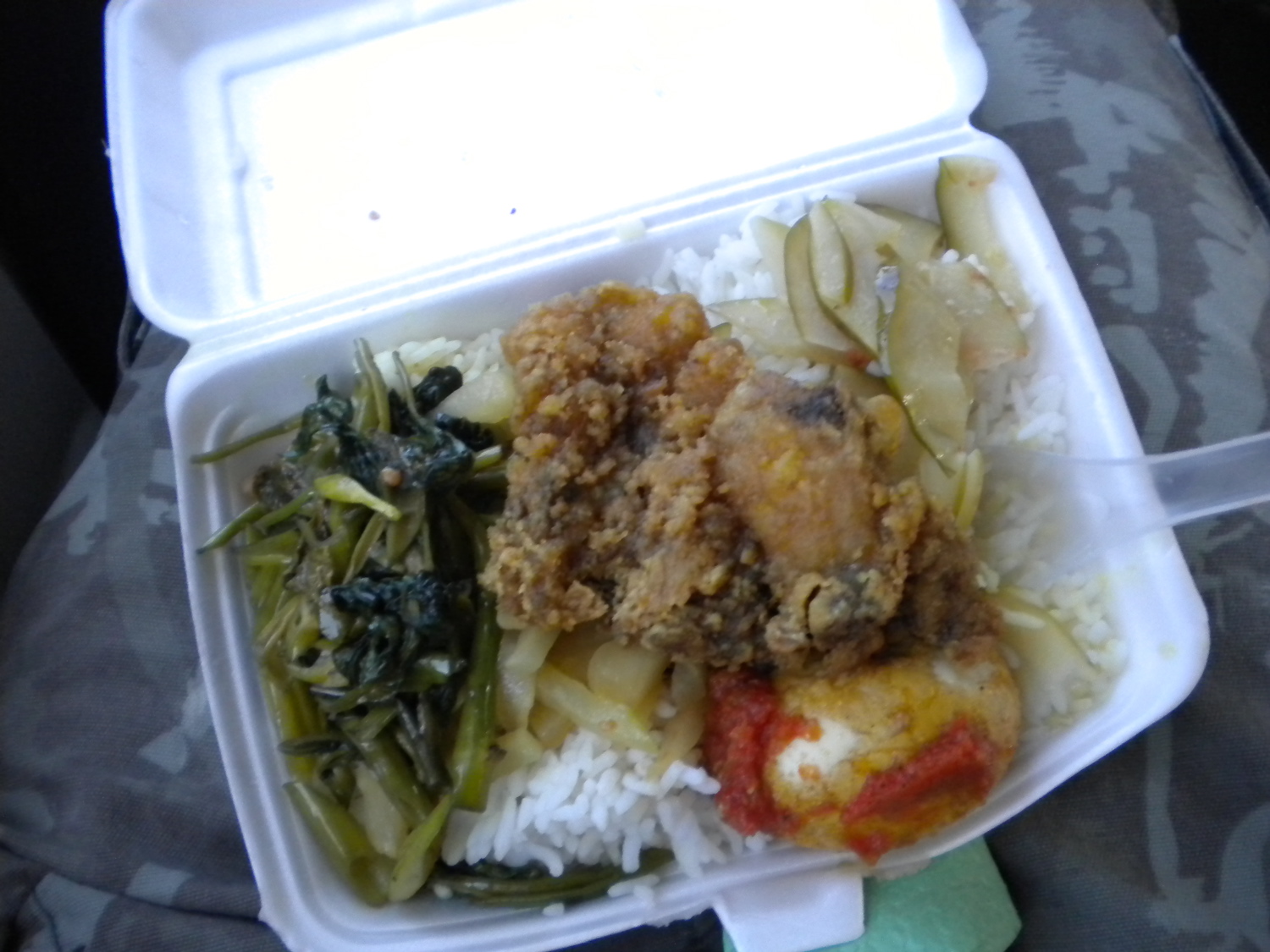
Typical lunch - $1.50!!!
Typical dinner.  and yes, we eat avocado almost every night!


Clinic:
One of several clinic ambulances.  

Our days alternate between working on a community public health project (detailed further on) and working at the Bairo Pite Clinic (clinic description can be found in the previous blog posting).  The day starts at 8am with teaching ward rounds facilitated by Dr. Dan.  Starting with the maternity ward and progressing through two tuberculosis wards, a larger general adult and pediatric medicine ward, several isolation rooms and finishing with a pediatric/malnutrition ward a small group of volunteer students, visiting health professionals, and Timorese staff learn create plans for the day for each patient with Dr. Dan.  There are roughly 50 inpatient beds and rounds last till 9:30 or 10am.

Bairo Pite Clinic waiting room - normally much more full.  Dr. Dan sees
around 300 outpatients per day!

 
After rounds Dr. Dan begins his clinic (which he does 6 days per week and sees roughly 300 patients per day!  I didn’t think this was possible but after observing him I have seen that many people come for common and benign ailments such as a cold and he can spend very little time with them but he likes to see everyone because out of every 300 patients he will see 10 or so who have a serious illnesses occurring.)


Me and Sarah a med student from Australia in the main office where we students hang out and research about various cases and topics etc.
For the volunteers we spend our post round time completing tasks; for example: dressing wounds, draining abscesses in the small ER, buying chocolate milk/avocado/banana to have the kitchen mix a nutritious smoothie for a patient that cannot chew, researching about cases that the team is unsure of a diagnosis on, taking a patient to the national hospital to convince them she needed dialysis and a great many more.  The variety is endless and it is as hands on as you want to make it – great for self-directed learning!  The clinic shuts down from 12-2pm for a lunch/siesta (even in the rainy season it is still very hot and humid, I am guessing mid 80s to 90s and 75-85% humidity most days).  In the afternoon there is time for more tasks and then we conduct an afternoon student only wards round to make sure no one has decompensated/needs urgent changes in management.  Twice now I have stayed for a night shift split with other medical students to care for more urgent cases.  One was a young boy with tetanus and the other a man who went into hepatic encephalopathy (liver failure leads to build up of ammonia and other waste products in blood and leads to confusion). 

The young boy with tetanus died suddenly after doing well for almost a week.  It hit us all hard.  We had been controlling his spasms with regular diazepam but one night he had a sudden massive spasm and - we believe - underwent laryngospasm (contraction of the vocal cords prohibiting respiration).  He had never received a tetanus vaccine.  Death here has been much more present than it was for me in medical school in the US and it has been a hard adjustment.  It has been just over two weeks since we arrived and I have already pronounced 4 people dead.

Stephanie has been helping with general care of patients (such as applying aloe vera from the actual plant to a women with a severe entire body drug reaction causing over 90% of her skin to dry, crack and slough off in places).  However, most of her time has been devoted to the community health project (as well as working to sort out our lives here i.e. phones, electricity, supplies etc.).

Community Health Project:

Prior to our arrival we thought the community health project we would be assisting with was the development and sustainability of a program training women from rural communities to be skilled birthing attendants.  We are not doing this.  However, the project we are working on has both of us very excited.

Bairo Pite has long had a mobile clinic program that brings a medical student or doctor, interpreter, and nurse, to a rural community outside Dili in order to see patients, address basic problems, and bring any truly sick patients back to the clinic.  At present then, these clinics are purely curative, that is there is no effort made on community education and prevention of illness.  However, after over a decade of dealing with the terrible sequelae of preventable diseases such as rheumatic heart disease, tuberculosis, and even simple diarrhea Dr. Dan hopes to shift the focus of the mobile clinics to use them more as a platform for the prevention of illness in addition to direct patient care.  Ultimately, Dr. Dan hopes to reduce visits to those sites whose needs are already being fairly well met and begin to work with even more rural areas far to the east which at present have almost no access to health care – preventive or curative.  And he wants Stephanie and me to launch this initiative.


Stephanie with our good friend Lorenzo who is working with us on the mobile clinic project.  He spent 7 years in school in the states and thus has been a cultural and linguistic ambassador for us!

There are currently 12 mobile clinic sites, each visited every week or two.  They reside between 30 minutes and 3.5 hours away from the clinic, often along poorly maintained roads.  Our initial task therefore has been to visit all of these sites to assess the overall health of the community (specifically focusing on the areas of child health and nutrition, maternal health, and tuberculosis), remoteness of location, what other organizations (government and NGO) provide services, where community members access care, how long they must travel to do so, and lastly if community health workers reside in the community and if so assess interest on their part and the community in general regarding the formation of a stronger partnership with the Bairo Pite Clinic focused on education and prevention.

Lunch spot - under an animal shelter in a rain storm!
Another lunch spot on mobile clinics - the beach!

Based off our site visits we are creating recommendations for improvement of the mobile clinics and suggesting which sites could be visited less and/or cut all together.  We have already visited 8 of 12 sites and will report in detail on the project in coming entries.  However, right now my bottom is too sore to continue sitting and writing after a total of 6 hours bouncing around in the back of a land-cruiser ambulance traveling to the remote community of Atabae Dam Laran. 

Good bye for now!

Coming soon, “Challenges and Triumphs” of Timor Leste

Friday, October 19, 2012

Take the leap

News:

My exciting news is that at my brother's wedding on July 28th I met a special someone.  Her name is Stephanie and after being too afraid to get her number after the wedding I took the sneaky route and got it the next day from her cousin - Ha! (who happens to be my new sister-in-law - Alicia).  We stayed in touch after I returned to Wisconsin and I couldn't shake the feeling that despite her residing on the west coast and me in Wisconsin this was someone I could not pass on getting to know.  I just had this gut feeling...

So, after a couple of weeks of talking over the phone, I swallowed my fear and asked her what she thought of me flying out to visit her!

And, fortunately, she thought it was a great idea! (or I reckon I wouldn't be telling you this story would I:)  Our time together that visit was incredible and as evidenced by her coming to visit me in Milwaukee this past weekend things have continued to go well!

(Stephanie and me on a bike ride on a beautiful summer day in Portland!) 


(Stephanie at a recent friend's wedding; what a nice smile!)

The most recent exciting news is that Stephanie - you might want to take a seat for this one - will be joining me in East Timor for the entire 6 months to volunteer at the clinic...  (!)  I know, it seems crazy.  I meet a nice person, hit it off, and then invite them to work with me in a developing country full of tuberculosis and unsafe drinking water.

BUT, in defense of my sanity, I knew Stephanie was searching for a service-learning type adventure and was also in a position career-wise to take a chunk of time to make that dream a reality.  You also just have to meet her, Stephanie is a real go-getter and well-traveled herself.  The more I thought about the idea the less crazy it seemed.  So, I asked her.  I was on a labor and delivery night shift at the time and couldn't wait to ask so on a slow moment I sent her an email laying out my idea.  Her response was:

"OH MY GOSH!! You are blowing my mind yet again! Yes, I want to do this!!!!! AHHHHHHHHH, holy buckets of amazingness!!!!!!!!!!"

Which, I took as an affirmative:)

We are both extremely excited for this opportunity and have been busy preparing for the experience.  Which leads me to my next topic...

Timor-Leste:

For those that might have missed a previous entry East Timor (or Timor-Leste as it is called by those who live there) is one of the world's newest nations, gaining independence in 2002 after 3 years of bloody conflict with indonesia that followed a 25 year annexation.  By the time the indonesian military departed, the country was in ruins and most of the health infrastructure and other public institutions were destroyed.  It was into this gap that Dr. Daniel Murphy and the clinic he founded - Bairo Pite Clinic - stepped in to make a difference.  However, the going has not been easy.

Tuberculosis, malaria, and dengue are all common maladies.  Home births without access to a health provider have lead to high maternal mortality.  One out of every 270 pregnant women in East Timor dies during or shortly after their pregnancy; this is 47 times the rate of nearby Australia and trails only Afghanistan, Nepal, and Laos for the highest maternal mortality in all of Asia (1).

The Bairo Pite Clinic, located in the country's  largest city Dili, sees an incredible number of patients each day (539 per day in 2009) and provides a wide range of services from tuberculosis and HIV testing and treatment to maternity care.  They do all of their work on roughly $17,000  per month or $570 dollars per day!

(Patients waiting to be seen at the clinic - photo from BPC website)

For more details on the clinic and incredible work they do please see the clinic's website at the following link:

http://bairopiteclinic.org/welcome/

My role working  at Bairo Pite will be two-fold.  First, I will spend time caring for patients in the out-patient clinic, in-patient ward, maternity ward, small emergency room, as well as mobile clinics to out-lying communities.  My second role will be to assist the Maternal Child Health Program (MCHP) of the clinic which is training women from outlying communities to be skilled birth attendants with the goal of reducing maternal and neonatal mortality.

Stephanie will also be working to care for patients at the clinic and specifically with patient's needing rehabilitation.  In addition, she is a certified yoga instructor and the head of the clinic has suggested she teach the staff yoga!  We have been informed many of the staff are trying to learn English and this is another potential area where she is excited to contribute.

In preparing for this experience I looked into bringing medications and equipment but kept running into issues.  Procuring medications and/or supplies is not simple.  Aligning what people are willing to donate with what the clinic actually needs can be troublesome.  Transporting large quantities of medications and supplies across country lines can result in substantial tariffs, etc.  In the end I have decided to focus my efforts generating funds and plan to let the staff at the clinic put them to use where they are most needed.  I succeeded in obtaining one fellowship to support my work with the Maternal Child Health Program and will be using those funds as well some of my own.  I am also taking over funds from a Madison, WI based group that are long time supporters of the clinic.

And, I want to know if you would like to contribute to the clinic's work.

I know these are hard times but if you feel this is a place and cause you would like to support I promise to keep you up to date with how your funds impact the clinic and the MCHP.

I will be at my present address (2) until mid-December if you would like to donate by check.  The BPC website has a donation link but I have been told the best way to maximize funds getting to the clinic is to bring them directly and/or create an account with a local bank in Timor-Leste and then do a one time transfer of funds (which can then be pulled out without losing money to ATM charges).  This is why the Madison group is having me bring their donation.  If you cannot or prefer not to support by check but would like to contribute I have a Paypal account we could us, just let me know.  While I cannot give you 501c3 status to get a tax refund I can promise to closely update you on how your generosity is making a difference in the lives of real people.

Thank you for reading and your consideration of supporting the people of Timor-Leste.

And as always I would love to hear how you are and what you are up to!

Warm regards,

Michael and Stephanie


1. World Health Organization (WHO) website, authors WHO Country Facts
http://www.who.int/countries/en/ [Accessed 1/14/12]

2. my address:
Michael Wauters
3011 S. 56th St. APT 7
Milwaukee, WI 53219


Saturday, August 25, 2012

Milwaukee Spring + Summer 2012


Bike Project!

For those that do not know I am currently residing in Milwaukee as part of a program that focuses on urban under-served medicine and public health.  Thus, in addition to time in the clinic and hospital, we receive dedicated hours to work on a public health project.  I have been partnered with the Sixteenth Street Community Health Center (a group of clinics in South Milwaukee that primarily work with Latino patients).  My first project revolved around access to healthy and affordable food in the local communities and is detailed in a prior blog entry.  Since that time I have been working on something new...

Biking!

When I first arrived in Milwaukee I was told, hey, there is a pediatrician who is into bikes, you should talk to him.  I did, his name is David Waters (strange coincidence on the name huh?), and we immediately hit it off.  Based off our own experiences with the benefits and joy bicycle use can bring and newer research demonstrating huge gains in health and staggering cost savings if short inner-city trips less than 8km are replaced by bike we set out to see what we could do on the south side of Milwaukee to increase bicycle use. (if you are interested in the article please see: http://www.ncbi.nlm.nih.gov/pubmed/22049372)

After months of connecting with local community members as well as bike shops and organizations involved with bicycle use and advocacy we decided to take a dual-pronged approach of 1) holding an event to create excitement around bicycle use as well as 2) conduct a survey to delineate a more evidence based approach to increasing bicycle use on the south side.  The survey is in it's final revisions but just last Saturday we held the first annual Southside Bicycle Day and it was a huge success!  See pics below:


Our Bike day logo!

 We estimate between 100 and 130 community members showed up!  We had representatives from the Wisconsin Bike Fed teaching about safe city riding, free helmets we fit on kids (ran out and will need more next year), the Urban Ecology Center, The Hank Aaron State Trail (a great riding/walking path along a river close to the community that almost no one at the event had heard of!), Milwaukee Police Bike unit, bike mechanics from two local shops offering free safety checks and minor repairs to all comers, and lastly free t-shirts and food to top it off.


 Officer Lemke from the MPD bike unit and me with a girl who really wanted a pic with us!


Officer Lemke leading a group on one of two groups rides he conducted on the park's trails during the event.  It was awesome to see 30-40 kids and adults stretched out behind the officer in their orange event t-shirts like little ducklings!


Signing kids up for the next ride.


Anton from Ben's Cycle Shop gettin' things done!  Our volunteer mechanics (also Russell from Dream Bikes) were a huge asset to have at the event - thanks guys!


Melissa from the Hank Aaron State Trail about to explain to another participant the wonders of the trail and how to best access it.  Nice!


 Our planning team minus Dr. David Waters who could not attend unfortunately (but has been instrumental in making things happen).  L-R Ed, Tatiana (my "boss" so to speak), and me.  Couldn't have asked for better people to work with!


-------------------------------------------------


Other Awesome stuff I want to share...

Wedding!

No, not mine, my brother Matthew got married!  His wife, and my new sister in law, is Alicia, and we couldn't be more excited to "officially" have her as part of the family!  The big day was July 28th and we held the wedding and reception at my parent's place on Bainbridge Island.  I was worried hosting the wedding would get us all stressed out but in the end we all banded together to get the work done, enjoyed each other's company and that of many family members and friends we had not seen in some time, and had a great day!  The sun even came out right in the middle of the outdoor ceremony - beautiful - we couldn't have asked for more:)  Congrats Matthew and Alicia!

Patrick and me tag-team toasting our brother Matthew and his wife Alicia - great fun!


Couch Surfing!

The title pretty much says it all.  In response to living alone in a two-bedroom apartment and being rather lonely at times I signed up for a website called couchsurfing.  The basic premise is to connect people who are willing to let someone stay with them for a night or two with travelers coming through. I was skeptical at first but the site has each person create a profile you can review and after meeting/hosting the two respective parties provide feedback i.e. "_____ was great to talk with, helped with dishes, and was very neat."  While I am not in a position to travel right now I have hosted some pretty cool people from all over the US as well as India, Germany, China, French and Italy!  And the bonus, the people I have hosted have all invited me to visit them in their countries - essentially I am creating a world-wide network of friends!


Karo from Germany and Spring (adopted name) from China.  We were just sitting down to an amazing chinese feast prepared by Spring!  Spring also helped me clean my kitchen and bathroom without me asking for it (don't worry mom, they weren't too bad to start with:)


Visiting a kite festival on Milwaukee's lakefront with two gals from France who visited me.  They had some huge kites!  The one's in the pic were at least a 100ft long!


Visit from my brother!

The evening after I finished 9 hours of testing for my Step 2 United States Medical Licensing Exam I had the awesome reward of being able to pick up my brother Patrick from the Milwaukee airport.  We had 5 days together and we packed it full of fun and adventure - two 60+ mile bike rides, several smaller rides, time at the lake front, a 10-12 mile trail run, cooking up huge feasts (including making pizza from scratch!), having friends over for dinner, visiting our grandfather and more.  It was a blast to show off my new home to someone who shares so many life passions with me!


The pizza team!  It was my first time making pizza from scratch and it turned out delicious!  L-R my brother Patrick, me, and my former med school roommate Anst who came for a day of adventuring with us.


Using basil from our med student garden we made home-made pesto, then added feta, brocolli, and mushrooms to top it off - yum!


Surgery Sub-Internship

From the above stories/pics you might think I am no longer in med school but this is not at all the case!  The fact that I only have time to write every few months is testament to my normal state of affairs:)

Third year ended well, I took my step 2 exam and I am now nearing the end of my first clinical 4th year rotation.  In the 4th year we are able to set our own schedule as long as we meet certain requirements.  I have started out with a month of general surgery and had the good fortune of being with a surgeon who is amazing and breaks all the stereotypes.  Dr. A loves to teach, is an incredible communicator and beloved by his patients, and has provided me with a great deal of responsibility and learning opportunities.

For example, one of the days we were on call Dr. A was in the operating room (OR) when he was paged by the emergency room (ER) that they had a patient with CT evidence of a perforated appendix and free air in the abdomen.  In medicine, free air is almost synonymous with a speedy trip to the OR for emergency surgery.  It usually indicates there is a hole somewhere along the person's intestinal tract and the patient is in acute danger.  Being scrubbed-in on a case Dr. A asked me to go to the ER in his stead, evaluate the patient, and report back to him with what I thought we should do.  Yikes!  This was the real deal!

Trying to remember the key history and physical elements of appendicitis and the criteria for sepsis I hurried down to the ER.  The patient I encountered was a 69-year-old man from a nursing home, wheel-chair bound after two strokes, with bad COPD (a bad lung disorder) and numerous other medical conditions.  While he was uncomfortable and had a distended abdomen he was not in acute pain and I could find no signs of peritoneal inflammation (certain signs that tell us extreme badness is happening inside the abdomen).  From what I could gather his intestinal perforation likely took place a week or so ago and what had brought him in acutely was nausea/vomiting and food intolerance secondary to his intestines becoming blocked or ceasing to function due to the inflammation/irritation within.

With his many co-morbidities and stable clinical picture I did not think taking him to the OR emergently was a good plan and might in fact do more harm than good.  However, I did not know if this was correct and bounded upstairs to share my assessment and plan with Dr. A.  After hearing my presentation he agreed with me (!) and upon seeing the patient himself he reaffirmed the plan.  Our patient is still in the hospital but has made moderate improvements and so far it has not been necessary to take him to the OR.

Needless to say, experiences such as this have provided me with a great deal of learning.  As I continue to gain more knowledge and confidence it has been most exciting!

Well that's all for now - please write back if you can!


Sunday, April 29, 2012

Milwaukee

Starting in January I moved from Madison to Milwaukee to begin my 1.5 year long participation in the TRIUMPH program (TRaining In Urban Medicine and Public Health).  TRIUMPH focuses our learning on the needs of urban underserved populations and integrates public health into our clinical training.

There are 8 of us total, each person working with a local community partner on a variety of projects. I have been partnered with the Sixteenth Street Community Health Center (SSCHC) located on the near south side of Milwaukee.  They are a federally qualified health center with family docs, pediatricians, mental health specialists and more and they specialize in working with the Latino community.  In many ways it reminds me of SeaMar where I worked during Americorps.

(The TRIUMPH team!  A wonderful group of people.)


My role at SSCHC has evolved into two separate projects united by a common goal.  The goal is wellness promotion in the Latino community and specifically reducing obesity.  My first project assists a educational program run through the clinic called Healthy Choices.  It consists of 3 months of once per week 2 hour classes that each incorporate a main lesson ranging from why water is better than soda to the benefits of whole grains as well as introducing new types of exercise each session (yoga, zumba and more) and finishing with a healthy snack.  The program is targeted at the entire family and indeed there are 4 different curriculums for different age ranges (4-6 year olds, 7-11, teens, and adults) who all focus on the same message of the day but with age appropriate material.  The participants come to support each other and many a parent has said it is their child who begs to go and continues the family's participation!  

Graduates of the program feel they know how to eat healthier but do not know where to get healthy food at the best price.  My task was to visit 10 local supermarkets and find out which one's had healthy options and at what price.  After doing this I created a comparative shopping guide we now provide to the families and also gave several presentations on the results of the study.  The main findings were:
1) there is a great deal of variety in the availability and price of healthy food items in the neighborhood between different stores.
2) The supermarkets marketed to and most frequented by Latinos had the fewest healthy options and those they did have often had the highest price tag.
3) It is possible (theoretically) to buy healthier food and save money in the neighborhood (buying less meat is a key part).


(At one of the presentations.  I had to learn a few new words such as ajonjoli (flax seed) which was a tough one for me to pronounce!)


My second project is only just beginning and the goal is to increase bicycle use and appreciation in the near south side of Milwaukee, especially within the Latino community.  A dream of our team is to one day hold a Ciclovia.  For those who do not know what this is check out an example at the following link: http://www.ciclavia.org/about/
More on this project in the future.


Recent Life Highlights/News

OB/GYN:
Crazy rotation but I really enjoyed it.  Working in one of Milwaukee's large public urban underserved hospitals we encountered all kinds of extreme cases and I think I saw almost every major obstetrical (having babies) complication there is!  See my previous post from February for a story about one of them.

Am I in Alaska?:
First, let me set the stage with a little background info. Milwaukee sits on the western edge of lake Michigan and right through the middle of it runs the Menominee river valley. This symbolic rift divides one of America's most segregated cities, with the North being mostly African American and the south largely Hispanic. In bygone days the valley was the engine for Milwaukee's industrial powerhouse and as a result the river became incredibly polluted over time. Several decades ago the city decided to clean up the area and from past photographs you almost wouldn't recognize it now. The river meanders along forested banks and on land there are a plethora of new, greener, businesses and an awesome bike/walking path that goes from the lake many miles inland called the Hank Aaron State Trail (HAST).
(The HAST!) 

My first day biking on the HAST I noticed two people walking around in the shallows of the Menominee river. I had learned some of the info I shared above but still thought it not the brightest idea as I figured the river was probably none to clean after so many years of abuse. As I grew nearer I could see they were fly fishing and stopped to watch. This seemed rather futile as there couldn't possibly be any fish in the river. As that thought passed through my head I saw one of the men's poles give a heave and proceeded to watch them reel in some huge trout/salmon looking fish which I later came to learn was almost assuredly a cut-throat. I couldn't believe my eyes! It felt like I was in the middle of the wilds of Alaska!  Yet, a glance behind me revealed several sky-scrapers.  Definitely in the city.  Crazy.  So, if you want to come visit, don't forget your fly rod:)

Third Birkebeiner ski race: Due to a profound lack of snow this winter I skied exactly 3 times before the race this year. However, the cross training I got from biking the snow-free streets must have been enough as I did the hilly 50k course in my second best time (3:45 vs 3:30 last year and 4:05 my first year) which I was more than happy with.  XC skiing rocks!


Hanging out with my Grandfather: One of my original hopes when coming to Wisconsin was to reconnect with the substantial number of relatives on my mom's side of the family who call WI home. I have been able to spend time with many of them (all wonderful experiences - thank you!) but was really hoping to see my grandfather more. My new location in Milwaukee is just 5 miles from where he lives which as allowed us to get together on three occassions so far for such adventures as:  baking bread, watching Wisconsin in the March Madness tourny,  practicing knot tying, and the telling of many awesome stories (i.e. my Gpa recanting such incredible tales as how he was shot down in WWII, survived, was held prisoner, and eventually escaped).  I have an awesome grandfather.

(Preparing to chow down on one of the meals we created)


Bikes: Maybe it's because I'm working on a project to get more people biking that I've had bikes on the mind but for whatever reason I've been exceptionally excited about them and riding them all over. I've discovered an incredible network of paved and off-road paths/trails around the city and each weekend go out exploring more of them. On my last rotation (primary care) I had two clinics set at opposite sides of the city but I still wanted to bike. The round trip ended up being just over 30 miles but as my afternoon preceptor didn't start until 2pm I had enough time to bike the hour plus down to her clinic after my morning clinic. I think I might be in the best biking shape of my life from commuting so much! The downside of such high mileage with a pack on was lots of pressure on my wrists and "areas that don't like lots of pressure" so I recently got a rack and some panniers.  Best decision ever; I can't believe I didn't make the switch earlier!

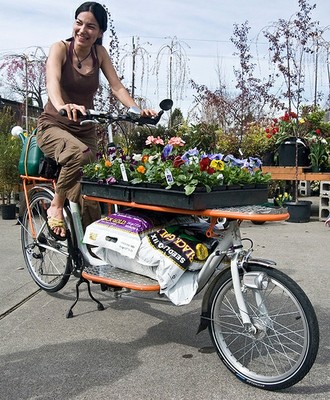
I've also become enamored of cargo bikes recently.  They can carry so much stuff you don't hardly need a car anymore!

(A smiling lady I do not know on a sweet cargo bike)

If you want to see more check out this awesome video of cargo bikes: 


Plans: In early January 2013, bar any unforeseen roadblocks, I will be heading to East Timor for 6 months to work in clinic and small hospital.  East Timor is roughly 400 miles NW of Darwin, Australia in SE Asia.  At that time I will also be assisting a Maternal Child Health Project that trains skilled birth attendants to help reduce the staggeringly high maternal and neonatal mortality in the country.  In preparation I am learning as much Tetum as possible (the most commonly used local dialect) and luckily have been put in touch with two fluent speakers who have graciously been my informal instructors for help with pronunciation and tricky grammar.

Ita diak ka lae?

To learn more about the clinic see:
http://bairopiteclinic.org/welcome/


Finale:
This video blew my mind.  Earth is an amazing, and fragile, place.  This video made that message hit home in a powerful way.
http://www.youtube.com/embed/nGeXdv-uPaw

Thanks for reading!